


What makes people feel they belong?
New findings from the National Church Life Survey

A report on the 2009 survey of Catholic Religious Institutes in Australia by Stephen Reid, Bob Dixon and Noel Connolly.
To view an electronic copy of the final report: click here.
National Catholic Census Project - Parish and Diocesan Social Profiles
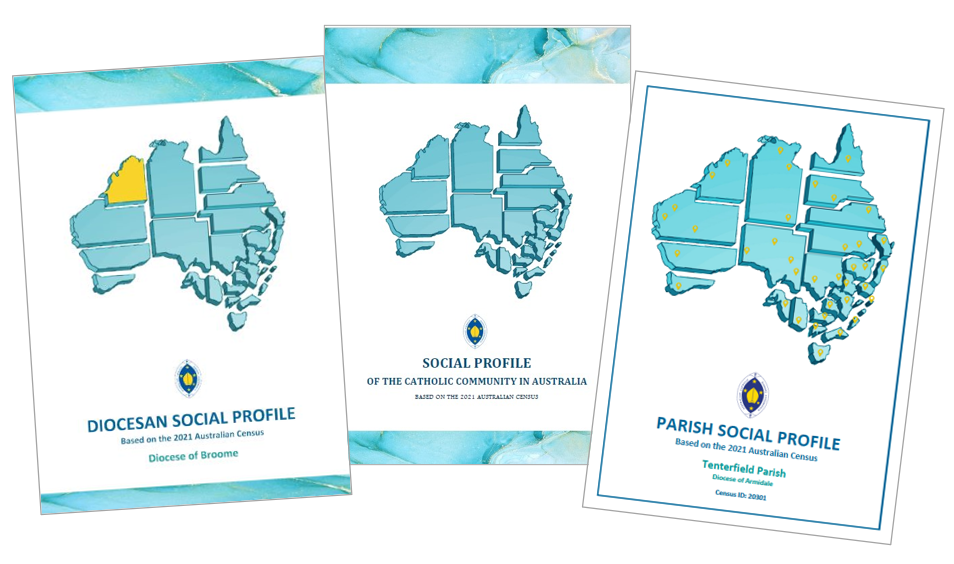
Australia's most recent Census was held on the night of 8 August 2006. As in earlier censuses, this office has acquired significant amounts of extra data about Catholics from the Australian Bureau of Statistics. Comprehensive reports on for all dioceses and parishes are now available.
To view diocesan and parish profiles based on the 2006 Census click here.
Other useful information and links:
A Profile of Australian Catholics
Australia's Catholics in 2006 - an extended profile
Previous census results: Catholics in the 2001 Census
Website link to: Australian Bureau of Statistics - Census
National Church Life Survey (NCLS) 2006
Website link to: NCLS Research
Over 500 Catholic parishes took part in the 2006 NCLS, along with parishes and congregations from around 20 other Christian denominations. To view the overall Catholic results, click on the link below:
Denominational Church Life Profile: the Catholic Church in Australia 2006
NCLS Research has created a series of Topic Papers for the Catholic Church in Australia based on results romthe 2006 survey. Click on the link below to view each topic.
Topic Paper 6 - Financial giving
Topic Paper 8 - Community connections
Topic Paper 9 - Children & youth
Topic Paper 11 - Leader strengths
NCLS 2001: Comparison of Australian and American Mass attenders.
What makes people feel they belong? 
September 2011
New research by Dr Bob Dixon, Director of the Pastoral Research Office of the Australian Catholic Bishops Conference, and Associate Professor Arunachalam Dharmalingam from Monash University on 2006 National Church Life Survey data show that Mass attenders’ perception of the leadership qualities of their priests and other parish leaders has a powerful bearing on their sense of belonging to their parish.
To view an electronic copy of the paper: click here.
April 2012
The 3rd National Count of Attendance was conducted in May 2011. Returns from parishes are in the process of being analysed, and it is expected that national results will be released by June 2012.
October 2008
The first National Count of Attendance was conducted in May 2001, and showed that approximately 765,000 Catholics, of all ages, attended Mass on a typical weekend. This figure represented about 15.3% of the Australian Catholic population.
The next national count was conducted in all parishes and other Mass centres throughout Australia during May 2006.
The count is conducted in the same year as the national census and the National Church Life Survey so that information collected can most effectively be used in association with results from the two larger projects.
Final Report for National Count of Attendance 2006.
Research Project on Catholics who have ceased attending Mass
Update July 2009
Final Report
For an electronic copy of the final report: click here.
Alternatively, click here to order your hard copy of the final report for $22 including GST, postage and handling.
Click here to see the statement issued with the report by the Australian Catholic Bishops Conference.
Consultation
Readers of the report were invited to take part in a consultation process designed to assist in the preparation of recommendations to help the Church enhance its pastoral practices. The recommendations focus on practical ways in which the Church at national, diocesan and parish level can address the issue of people ceasing to attend Mass.
A 'Pastoral Strategies' document was subsequently produced.
Catholics who have ceased attending Mass - Pastoral Strategies To see the full document outlining the recommendations, click here.
Response of the Australian Catholic Council for Clergy Life and Mission. To view and download the response of the ACCCLM to the report, please click here.
Who Goes When? Mass attenders and their usual Mass time
A report to the Australian Catholic Bishops based on the 2001 National Church Life Survey by Bob Dixon and Sharon Bond for Australian Catholic Bishops Conference Pastoral Projects Office, November 2004.
Results at a Glance:
Parishes with Sunday evening Masses
In the major cities, parishes which provide a Sunday evening Mass tend to have:
Attenders in these same parishes tend to have a weaker sense of belonging than attenders in parishes which don't have a Sunday evening Mass. Only one of these effects is found in parishes outside the major cities: those which have a Sunday evening Mass tend to have a larger overall attendance than those which do not. Providing a Sunday evening Mass is potentially one way in which a parish can increase its attendance and, in the major cities at least, attract more young adults. On the other hand, a parish which discontinues its Sunday evening Mass risks losing its best opportunity of contact with young adults.
Characteristics of attenders at different Mass times*
People who attend Mass at different times are quite different from one another. They differ in their demographic makeup, their levels of parish involvement and in their experience of the liturgy.
In particular, Sunday evening congregations differ markedly from those that meet on Saturday evenings and Sunday mornings. They have a much younger average age, a much more even gender balance, more people with a tertiary education and a much higher proportion of people who do not live in the parish where they attend Mass. Sunday evening attenders tend to attach less importance to the place of the parish in their lives and to derive less satisfaction from the liturgy than attenders at other Mass times.
These differences have pastoral implications that need to be considered by all those interested in the mission of the parish.
Age
Education
Length of attendance
Home location
Sense of belonging
Preferred style of music
Experience of liturgy
* Age plays a part in many of the findings presented here, but in most cases the differences between attenders at different Mass times remain even after controlling for age. One exception is attenders' experience of liturgy: most of the difference between groups attending Mass at different times is due to variation in their age profiles.